
Why SaaS Lead Generation Is Different B2B lead generation strategies for SaaS companies works very differently from traditional service businesses or ecommerce brands. SaaS buyers don’t wake up and book a demo impulsively. They research it first. Then compare the tools. Then they read blogs, watch videos, ask peers, and shortlist options long before speaking to sales. In many cases, multiple stakeholders are involved, and the buying cycle stretches across weeks or even months. That’s why many SaaS companies feel stuck.Traffic is coming in. Leads are being generated. But conversions don’t match expectations. The issue is rarely effort.The issue is strategy. In earlier blogs, we discussed how inbound vs outbound lead generation, MQL vs SQL, and lead scoring shape the buyer journey. This blog builds on that foundation and focuses specifically on what actually works for SaaS companies in 2026. 1. Content-Led Inbound Marketing That Educates Before It Sells Inbound marketing remains one of the most effective B2B lead generation strategies for SaaS companies — but only when done correctly. SaaS buyers are problem-aware long before they are product-aware. They search for solutions, frameworks, comparisons, and best practices before they ever look for a specific tool. Content helps you enter that conversation early. Instead of writing product-heavy blogs, high-performing SaaS companies focus on problem-first content. They explain challenges, industry trends, mistakes, and better ways of doing things. Over time, this builds trust and authority. When inbound content is done right, it naturally produces Marketing Qualified Leads (MQLs) — readers who understand the problem and see your brand as credible, even if they’re not ready to buy yet. 2. SEO as a Long-Term B2B Lead Generation Engine SEO is one of the most sustainable lead generation strategies for SaaS companies, but it’s often misunderstood. SaaS SEO isn’t about ranking for generic keywords. It’s about capturing intent at different stages of the funnel. That includes: When SaaS companies align their SEO content with buyer intent, the traffic they attract is far more qualified. These visitors arrive with context, questions, and genuine interest. Over time, SEO reduces dependency on paid ads, lowers cost per lead, and feeds inbound demand consistently — making it a foundational pillar in most successful SaaS growth engines. 3. High-Intent Lead Magnets That Qualify, Not Just Capture Lead magnets still work — but only when they’re specific. Generic ebooks and broad whitepapers rarely qualify SaaS leads anymore. Modern buyers want quick, practical value. The best SaaS lead magnets solve one focused problem and naturally connect to the product. Examples include calculators, templates, checklists, audits, or short playbooks. These resources don’t just capture emails; they signal intent. When paired with lead scoring, these magnets help identify which users are exploring casually and which are moving closer to a buying decision. 4. Product-Led Growth (PLG) Through Free Trials and Freemium Models Many SaaS companies generate their highest-quality leads inside the product itself. Free trials and freemium models allow prospects to experience value before committing to a sales conversation. This lowers resistance and builds confidence organically. However, PLG works best when combined with structure. SaaS teams that succeed here monitor product usage, onboarding behavior, and feature engagement. These signals are far stronger than form fills alone. This is where behavior-based lead scoring becomes critical — helping sales teams engage only when usage shows real intent. 5. Outbound Lead Generation That Feels Relevant, Not Random Outbound lead generation still works in 2026 — but not in its old form. Generic cold emails and mass outreach fail because SaaS buyers expect relevance. Effective outbound today is targeted, personalized, and often triggered by prior engagement. Strong SaaS outbound campaigns are built around: When outbound follows inbound exposure — such as content views or site visits — response rates improve dramatically. This reinforces the idea we discussed earlier: inbound warms the market, outbound accelerates conversions. 6. LinkedIn as a Demand Generation Platform for SaaS For B2B SaaS companies, LinkedIn is not just a social platform — it’s a demand generation channel. Consistent, insight-driven content helps SaaS brands stay visible during long buying cycles. Buyers may not convert immediately, but repeated exposure builds familiarity and trust. Over time, this demand generation effect: LinkedIn content works best when it focuses on lessons, insights, and industry experiences rather than direct promotion. 7. Webinars and Live Sessions for Mid-Funnel Lead Generation Webinars continue to be one of the highest-intent channels for SaaS lead generation. Unlike passive content, webinars require time commitment. That alone signals higher engagement. When webinars are educational rather than sales-heavy, they attract serious prospects who are actively evaluating solutions. Webinar attendees often move faster from MQL to SQL, especially when follow-ups are personalized and aligned with the topic discussed. 8. Retargeting and Nurture Campaigns That Respect the Buyer Journey Most SaaS leads don’t convert on their first interaction. Retargeting allows SaaS companies to stay present while prospects continue their research. When paired with thoughtful email nurturing, it helps address doubts, reinforce value, and build confidence. Retargeting works best when messaging changes based on stage — educational early on, proof-driven later, and conversion-focused at the bottom of the funnel. 9. Partner-Led and Integration-Based Lead Generation Partnerships are often overlooked, yet extremely powerful for SaaS lead generation. Integrations, co-marketing campaigns, and partner webinars introduce your product to an already relevant audience. Because trust already exists, leads from partners often convert faster and with less resistance. This strategy works particularly well for SaaS products that complement existing tools or workflows. 10. Lead Qualification and Scoring to Protect Sales Time Generating leads is meaningless without qualification. The most successful SaaS companies focus less on volume and more on lead readiness. They score leads based on fit, behavior, and intent — ensuring sales teams engage at the right moment. As discussed in our earlier Lead Scoring and MQL vs SQL blogs, this alignment between marketing and sales is what turns lead generation into predictable revenue. How These Strategies Work Together High-performing SaaS companies don’t rely on one channel. They combine: This
What Is a Qualified Lead? MQL vs SQL Explained (2026 Guide)
Understanding Lead Qualification in Modern B2B Marketing In our previous blogs, we discussed how lead generation works, and how inbound vs outbound strategies shape that journey in 2025. But generating leads is just the first half of the equation. The real challenge begins after someone fills out a form, downloads a resource, schedules a demo, or replies to outreach. At that point, every company faces the same question: 👉 “Is this lead actually worth pursuing — or will it waste time?” This is where lead qualification comes in — separating casual interest from real buying intent. In this guide, we’ll break down what makes a lead truly qualified, the difference between MQLs and SQLs, and how companies in 2025 decide when a prospect is ready for sales. What Is a Qualified Lead? A qualified lead is a potential customer who fits your target profile and shows real interest in your product or service — enough to justify nurturing or engaging them further. A qualified lead meets two requirements: If a prospect only fits one of these — they’re not yet qualified. For example: Lead Type Fit Intent Qualified? A student downloading your B2B checklist ❌ ✔ ❌ A CEO visiting your pricing page and scheduling a demo ✔ ✔ ✔ A relevant decision-maker who never engages ✔ ❌ ❌ A lead is qualified only when both conditions align. Why Lead Qualification Matters in 2025 The buyer journey has changed. Today’s prospects: That means your CRM may fill up with leads — but not all of them are ready or relevant. Without proper qualification: ❌ Sales pipelines become chaotic❌ Sales reps waste time on poor leads❌ CPL (Cost Per Lead) looks good but CAC (Customer Acquisition Cost) increases❌ Conversion rates drop❌ Growth becomes unpredictable With proper qualification: ✅ Sales teams focus on high-probability deals✅ Marketing efforts feel aligned✅ Follow-ups become meaningful✅ Conversions and revenue increase Lead qualification isn’t just a filter — it’s efficiency. Two Main Lead Qualification Types: MQL vs SQL To make qualification structured, most companies use two important lead categories: Let’s break these down. What Is an MQL? (Marketing Qualified Lead) An MQL is a lead that shows interest or engagement with your brand — but is not yet ready to talk to sales. They are aware of their problem and exploring solutions, but still in research or comparison mode. Examples of MQL Behavior A lead may become an MQL if they: These actions suggest curiosity — but not commitment. MQL Funnel Stage MQLs live in the Middle of the Funnel (MOFU) — right after awareness, before decision making. Goal with an MQL The objective is NOT to sell. The goal is to: 👉 Educate👉 Nurture👉 Build trust👉 Provide value Because if they are nurtured well enough, they will move forward to the next phase: SQL. What Is an SQL? (Sales Qualified Lead) An SQL is a lead who is ready to talk with the sales team. They: Examples of SQL Behavior A lead becomes SQL when they: These actions show readiness — not research. SQL Funnel Stage SQLs live in the Bottom of the Funnel (BOFU) — where deal conversations begin. Goal with an SQL The goal is: 👉 Qualification → Presentation → Proposal → Close Sales involvement begins here. Key Differences: MQL vs SQL (Quick Table) Factor MQL SQL Intent Level Medium High Readiness to Buy Not yet Yes Who Handles? Marketing team Sales team Funnel Stage Middle (MOFU) Bottom (BOFU) Common Actions Learn, download, engage Book demo, ask pricing How Leads Move from MQL → SQL Not every MQL becomes an SQL — and that’s normal. The transition happens when: 1. Fit + Intent Align ICP match + strong signals = SQL. 2. Lead Scoring Threshold Crossed Lead scoring assigns points based on: Example scoring model: Action Points Downloaded ebook +10 Watched webinar +20 Visited pricing page +30 Booked demo +100 When the score crosses a threshold (e.g., 70 points), the lead becomes SQL. Where This Fits in the Full Funnel From our earlier blog on Inbound vs Outbound Lead Generation, we saw that prospect journeys vary depending on how leads enter the funnel. Here’s how qualification fits into that journey: No matter the path — qualification improves predictability. Examples: Turning Leads Into Qualified Leads Example 1 — Content Download (Inbound MQL → SQL) ✔ Final status: SQL Example 2 — Cold Outreach (Outbound → Immediate SQL) ✔ Final status: Immediate SQL Example 3 — Social Engagement (Slow MQL → SQL) ✔ Final status: SQL Common Lead Qualification Frameworks To avoid guesswork, many companies use qualification models like: No model is perfect — but each brings structure. Best Practices for Lead Qualification in 2025 To qualify leads effectively: ✔ Align marketing & sales definitions✔ Use consistent scoring rules✔ Review scoring and adjust quarterly✔ Track funnel performance✔ Personalize follow-ups based on lead stage✔ Use automation, but NEVER lose the human element Qualification is not a single action — it’s a process. Conclusion A lead becomes qualified when two criteria meet: 👉 They fit your ideal customer profile.👉 They show real buying intent. MQL and SQL aren’t just labels — they guide messaging, timing, and ownership between marketing and sales. In 2025, the companies winning at B2B lead generation aren’t just generating leads — they’re qualifying them properly, nurturing intelligently, and handing sales only the right opportunities. And that’s the difference between a full CRM and a predictable revenue engine.
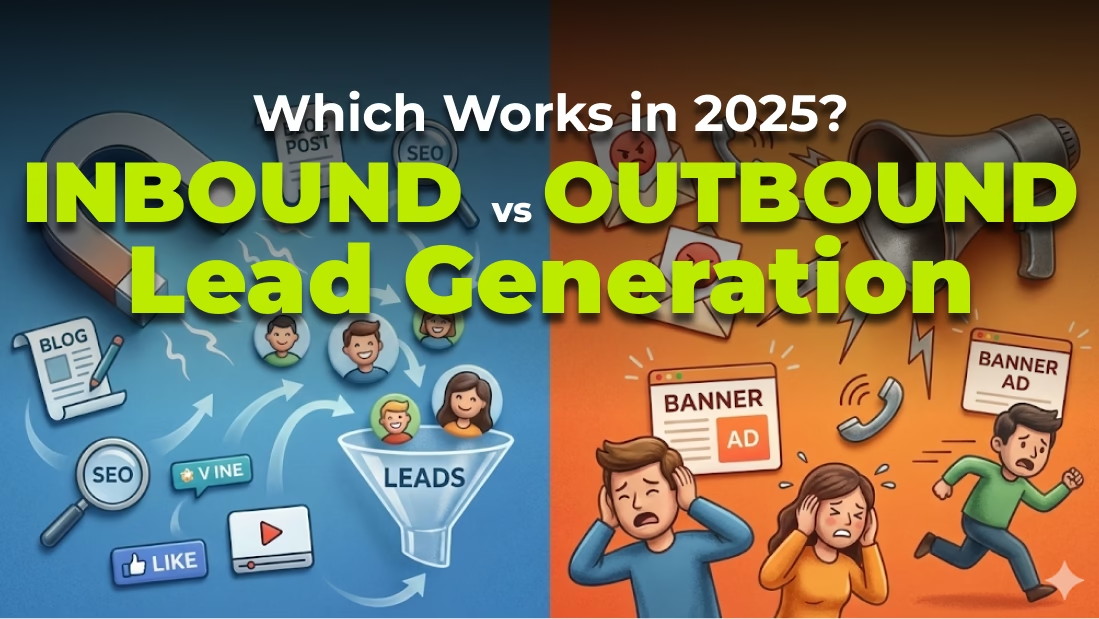
Inbound vs Outbound Lead Generation (2026 Guide + Strategy)
Understanding Inbound vs Outbound Lead Generation in 2025 B2B lead generation isn’t what it used to be. Inbound vs Outbound Lead Generation Five years ago, outbound dominated.Cold emails, cold calls, events, trade shows—everything was about pushing messages out. Today, the landscape looks completely different. Buyers are more informed.Competition is higher.Attention is shorter.And decision-makers hate being interrupted. But does that mean outbound is dead?Not at all. In 2025, inbound and outbound both work—but not the way they used to. They work together. This blog breaks down everything:What inbound and outbound mean, how they differ, their pros and cons, funnel stages, examples, and most importantly—which approach wins in 2025. Let’s start from the basics. What Is Inbound Lead Generation? Inbound lead generation means attracting prospects who come to you on their own.They discover your brand, consume your content, trust you, and eventually convert. Inbound is built on one principle: Provide value first, sell later. Inbound Lead Generation Examples Channels include: Inbound is slow at the beginning but powerful in the long run. It’s like planting seeds that keep growing every month, even while you sleep. What Is Outbound Lead Generation? Outbound lead generation means reaching out to prospects before they know you. Instead of waiting for them to come, you initiate the first touch. Outbound is built on: Identify → Target → Reach Out. Outbound Lead Generation Examples Channels include: Outbound is fast, predictable, and direct. When done well, outbound brings opportunities quickly—especially for B2B. Inbound vs Outbound: Key Differences Here’s the simplest comparison: Inbound Lead Generation Outbound Lead Generation Prospects come to you You reach out to prospects Runs on trust & value Runs on targeting & volume Cheaper long-term Faster short-term SEO, content, social Emails, calls, ads Builds brand authority Fills pipeline quickly Organic & sustainable Consistent but requires effort Buyers are warmer Buyers are colder Inbound is slow but powerful.Outbound is fast but competitive. Both play different roles—but you need both. Why Inbound Matters More in 2025 Let’s talk about buyer behavior. In 2025: This means: If you’re not visible online…If you are not publishing helpful content…If you’re not educating your industry…If you are not active on LinkedIn… You’re invisible. Inbound builds: It makes your brand familiar, which reduces the friction in outbound later. Why Outbound Still Works in 2025 Despite all the noise, outbound is still extremely effective. Here’s why: Outbound shines especially in: When done with personalization and smart targeting, outbound gets results fast. Inbound Funnel vs Outbound Funnel Both strategies follow different funnel paths. Inbound Funnel (Attract → Engage → Convert) 1. Attract SEO, blogs, social content, videos. Goal: bring them into your world. 2. Engage Lead magnets, email sequences, webinars. Goal: warm them up. 3. Convert Demos, calls, trials, consultations. Goal: turn them into revenue. Inbound is a slow burn but leads are warmer and cheaper. Outbound Funnel (Identify → Target → Reach Out) 1. Identify Find ICP companies & decision-makers. 2. Target Segment based on need, industry, revenue. 3. Reach Out Cold emails, calls, LinkedIn messages. 4. Follow-Up Nurture until they’re ready. Outbound is a fast engine but needs persistence and systems. Pros & Cons of Inbound Lead Generation Pros Cons Inbound is powerful, but not instant. Pros & Cons of Outbound Lead Generation Pros Cons Outbound works—but only with precision. How to Combine Inbound + Outbound in 2025 (Winning Strategy) Here’s a proven framework that top B2B brands use: Step 1: Build Inbound Foundation This builds your audience. Step 2: Warm Up the Audience Content types that warm up inbound prospects: This makes your brand familiar. Step 3: Launch Personalized Outbound Campaigns Reach out to: Warm outbound works 3x better than cold outbound. Step 4: Use Automation Smartly Tools for efficiency: Automation saves time but personalization drives replies. Step 5: Retarget Constantly Retargeting ads convert people who: Retargeting = BOFU gold mine. Step 6: Nurture Continuously Use: Nurturing turns “curious prospects” into “ready buyers”. Practical Example: How This Works Let’s walk through a real inbound + outbound flow: Step 1 — Inbound: A CEO reads your blog about “B2B lead generation tips”. Step 2 — Inbound: They start following you on LinkedIn. Step 3 — Inbound: They download your free checklist. Step 4 — Outbound: Your SDR reaches out with a personalized email. Step 5 — Outbound: They reply and book a call. Step 6 — Nurture: You send them case studies. Step 7 — Conversion: They sign up for your service. Here, inbound created trust.Outbound converted it. When Should You Focus More on Inbound? Inbound is best when: Ideal for: SaaS, agencies, consulting, B2B platforms, niche services. When Should You Focus More on Outbound? Outbound is best when: Ideal for: enterprise solutions, B2B services, appointment setting, manufacturing, IT services, and specialized consulting. Conclusion: What Works in 2025? In 2025, the most successful companies don’t ask: “Inbound or outbound?” They ask: “How do we combine both?” Inbound builds trust.Outbound creates opportunities. Inbound warms up your market.Outbound captures the demand. Inbound gives you authority.Outbound gives you pipeline. Together, they give you: The companies who master both will dominate 2025 and beyond.
The Complete Guide to B2B Lead Generation in 2026
Introduction B2B lead generation has changed more in the past 18 months than it did in the last five years. Buyer journeys are longer.Conversion paths are scattered.And decision-makers are harder to reach than ever. But the companies who understand how lead generation really works in 2025 are seeing better results than before—shorter sales cycles, better conversions, and consistent inbound demand. This guide breaks down everything you need to know. Let’s start with the basics. What Is B2B Lead Generation? B2B lead generation is the process of attracting potential business customers and converting them into sales-ready leads. Unlike B2C, where buying decisions are emotional and fast, B2B decisions involve: In simple terms:B2B lead generation is about finding companies that have a problem your solution can solve — and guiding them until they are ready to buy. Why B2B Lead Generation Looks Different in 2025 Traditional methods like cold calling, basic lead forms, and random bulk emails no longer work. Here’s what changed: 1. Buyers do 70% of research before speaking to a salesperson. Most prospects already know your competitors, pricing ranges, and features before filling out a form. 2. Attention spans are shorter. If your message isn’t clear, personalized, and value-focused, prospects will ignore it. 3. Privacy rules are stricter. Email scraping and mass outreach without compliance can damage your domain and credibility. 4. Personalization is no longer optional. Generic messages lose. Customized workflows win. Because of all this, B2B lead generation in 2025 requires a mix of inbound, outbound, and demand-generation strategies—not just one. Types of B2B Leads You Must Know Understanding the stages helps in creating the right campaigns. 1. TOFU Leads (Top of the Funnel) People who are aware of the problem and exploring solutions.Example: Visitors reading your blog or downloading ebooks. 2. MOFU Leads (Middle of the Funnel) Leads who know what they need and are comparing options.Example: Prospects attending webinars or subscribing to newsletters. 3. BOFU Leads (Bottom of the Funnel) Sales-ready leads who want demos, proposals, or a free trial.Example: A decision-maker requesting a consultation. The goal is simple:Move leads from TOFU → MOFU → BOFU without overwhelming them. How B2B Lead Generation Works in 2025 — Step-by-Step Here’s the exact path high-performing companies follow: Step 1: Identify Your ICP (Ideal Customer Profile) Your lead generation fails if you target the wrong audience. Your ICP should include: The clearer your ICP, the cheaper and faster your lead generation becomes. Step 2: Build a Strong Value Proposition Your message must answer one question: “Why should someone buy from you instead of your competitors?” A strong value proposition includes: Clear > Clever.Always. Step 3: Create Demand Before Asking for Leads This is where 90% of companies fail. Before collecting leads, you must build awareness and trust. Demand-generation channels include: People don’t buy immediately.But they remember you when they’re ready. Step 4: Use Multi-Channel Lead Generation In 2025, one channel is never enough.Winning companies use multi-touch strategies. 1. Inbound Lead Generation Inbound brings high-intent leads at a low cost. 2. Outbound Lead Generation Outbound works best for enterprise and mid-market deals. 3. Paid Lead Generation Paid campaigns accelerate lead flow instantly. 4. Content Syndication A top strategy for B2B in 2025. Your content is distributed across partner networks to generate verified leads at scale. Step 5: Qualify Leads with a Lead Scoring System Not every lead is ready to buy.Lead scoring helps prioritize. You can score leads based on: This helps sales teams focus only on leads that actually matter. Step 6: Nurture Leads Until They Convert Most B2B leads take 30–90 days to convert.Lead nurturing fills this gap. Ways to nurture leads: Nurturing increases closing rates by 2–3x. Tools You Need for B2B Lead Generation in 2025 CRM Tools Email Automation Prospect Data SEO & Content Using the right stack makes the entire engine smoother. Best Practices for B2B Lead Generation in 2025 Here are the rules successful companies follow: ✔ Personalization for every ICP Never send the same message to everyone. ✔ Use content to warm up prospects Great content reduces friction. ✔ Don’t rely on one channel Diversification reduces risk. ✔ Offer high-value lead magnets Templates, checklists, frameworks, reports. ✔ Use retargeting aggressively People rarely convert the first time. ✔ Measure everything CPL, CAC, conversion rate, pipeline velocity. Conclusion B2B lead generation in 2025 is not about mass outreach or buying lists.It’s about: Companies that follow this structured approach will consistently generate predictable, high-quality leads — regardless of market competition.
