
Introduction
B2B lead generation has changed more in the past 18 months than it did in the last five years.
Buyer journeys are longer.
Conversion paths are scattered.
And decision-makers are harder to reach than ever.
But the companies who understand how lead generation really works in 2025 are seeing better results than before—shorter sales cycles, better conversions, and consistent inbound demand.
This guide breaks down everything you need to know.
Let’s start with the basics.
What Is B2B Lead Generation?
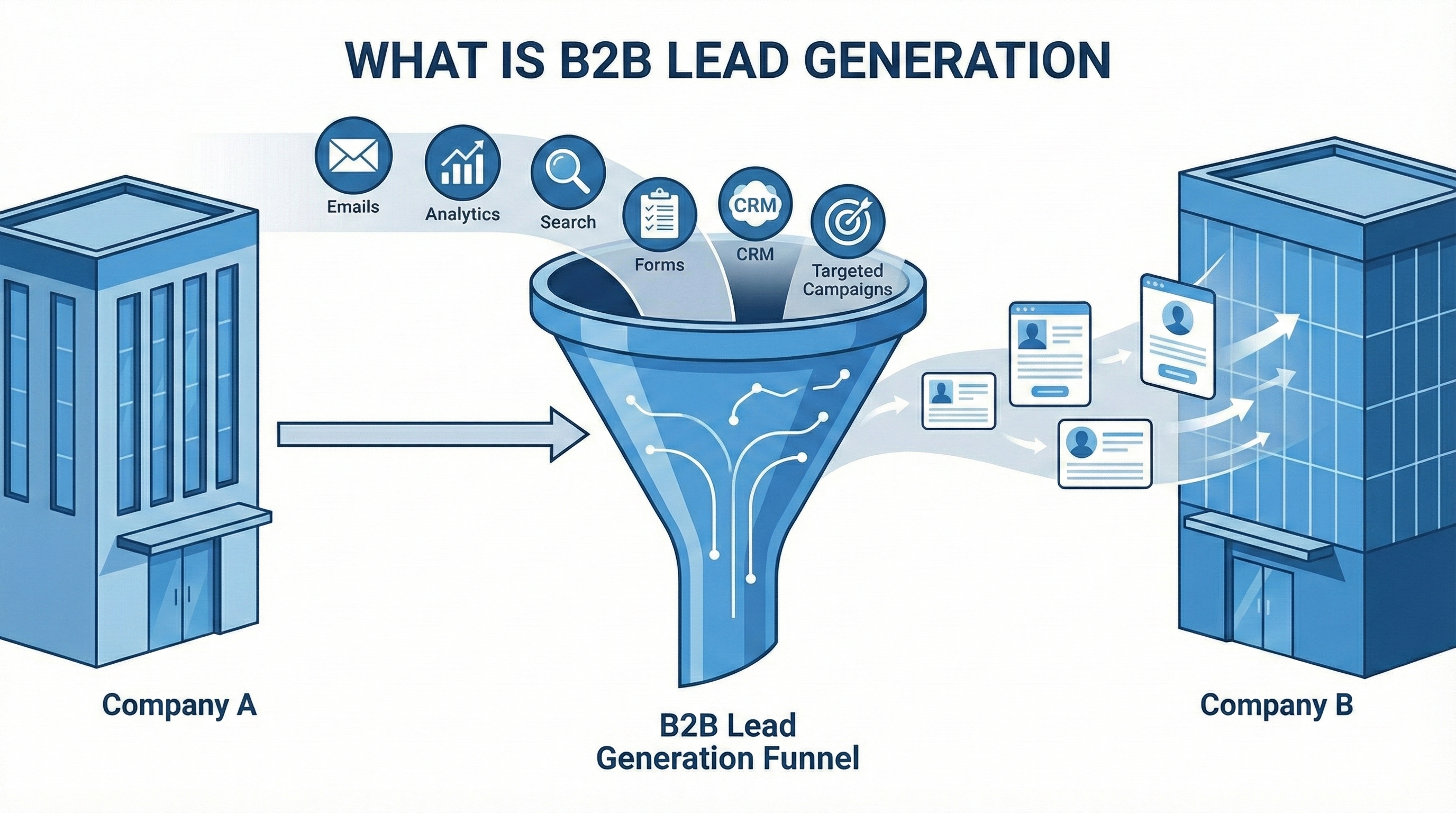
B2B lead generation is the process of attracting potential business customers and converting them into sales-ready leads.
Unlike B2C, where buying decisions are emotional and fast, B2B decisions involve:
- Longer buying cycles
- Multiple decision makers
- Higher deal values
- Comparisons, demos, and approvals
In simple terms:
B2B lead generation is about finding companies that have a problem your solution can solve — and guiding them until they are ready to buy.
Why B2B Lead Generation Looks Different in 2025
Traditional methods like cold calling, basic lead forms, and random bulk emails no longer work.
Here’s what changed:
1. Buyers do 70% of research before speaking to a salesperson.
Most prospects already know your competitors, pricing ranges, and features before filling out a form.
2. Attention spans are shorter.
If your message isn’t clear, personalized, and value-focused, prospects will ignore it.
3. Privacy rules are stricter.
Email scraping and mass outreach without compliance can damage your domain and credibility.
4. Personalization is no longer optional.
Generic messages lose. Customized workflows win.
Because of all this, B2B lead generation in 2025 requires a mix of inbound, outbound, and demand-generation strategies—not just one.
Types of B2B Leads You Must Know
Understanding the stages helps in creating the right campaigns.
1. TOFU Leads (Top of the Funnel)
People who are aware of the problem and exploring solutions.
Example: Visitors reading your blog or downloading ebooks.
2. MOFU Leads (Middle of the Funnel)
Leads who know what they need and are comparing options.
Example: Prospects attending webinars or subscribing to newsletters.
3. BOFU Leads (Bottom of the Funnel)
Sales-ready leads who want demos, proposals, or a free trial.
Example: A decision-maker requesting a consultation.
The goal is simple:
Move leads from TOFU → MOFU → BOFU without overwhelming them.
How B2B Lead Generation Works in 2025 — Step-by-Step
Here’s the exact path high-performing companies follow:
Step 1: Identify Your ICP (Ideal Customer Profile)
Your lead generation fails if you target the wrong audience.
Your ICP should include:
- Industry
- Company size
- Geography
- Tech stack
- Revenue
- Buyer responsibilities
The clearer your ICP, the cheaper and faster your lead generation becomes.
Step 2: Build a Strong Value Proposition
Your message must answer one question:
“Why should someone buy from you instead of your competitors?”
A strong value proposition includes:
- Who you help
- What problem you solve
- Why your solution is better
- What outcome your customer receives
Clear > Clever.
Always.
Step 3: Create Demand Before Asking for Leads
This is where 90% of companies fail.
Before collecting leads, you must build awareness and trust.
Demand-generation channels include:
- LinkedIn content
- Blogs
- SEO
- Industry webinars
- Case studies
- Business podcasts
- Social proof & reviews
People don’t buy immediately.
But they remember you when they’re ready.
Step 4: Use Multi-Channel Lead Generation
In 2025, one channel is never enough.
Winning companies use multi-touch strategies.
1. Inbound Lead Generation
- SEO
- Content marketing
- Landing pages
- Organic LinkedIn
- Lead magnets
- Webinars
Inbound brings high-intent leads at a low cost.
2. Outbound Lead Generation
- Personalized cold emails
- LinkedIn outreach
- Targeted calling
- Account-based outreach
Outbound works best for enterprise and mid-market deals.
3. Paid Lead Generation
- Meta ads
- Google search ads
- LinkedIn ads
- YouTube remarketing
Paid campaigns accelerate lead flow instantly.
4. Content Syndication
A top strategy for B2B in 2025.
Your content is distributed across partner networks to generate verified leads at scale.
Step 5: Qualify Leads with a Lead Scoring System
Not every lead is ready to buy.
Lead scoring helps prioritize.
You can score leads based on:
- Company size
- Budget
- Behaviour on website
- Job role
- Engagement level
- Time to purchase
This helps sales teams focus only on leads that actually matter.
Step 6: Nurture Leads Until They Convert
Most B2B leads take 30–90 days to convert.
Lead nurturing fills this gap.
Ways to nurture leads:
- Email drip workflows
- Automated sequences
- Retargeting ads
- Valuable content
- Case studies
- Webinars
Nurturing increases closing rates by 2–3x.
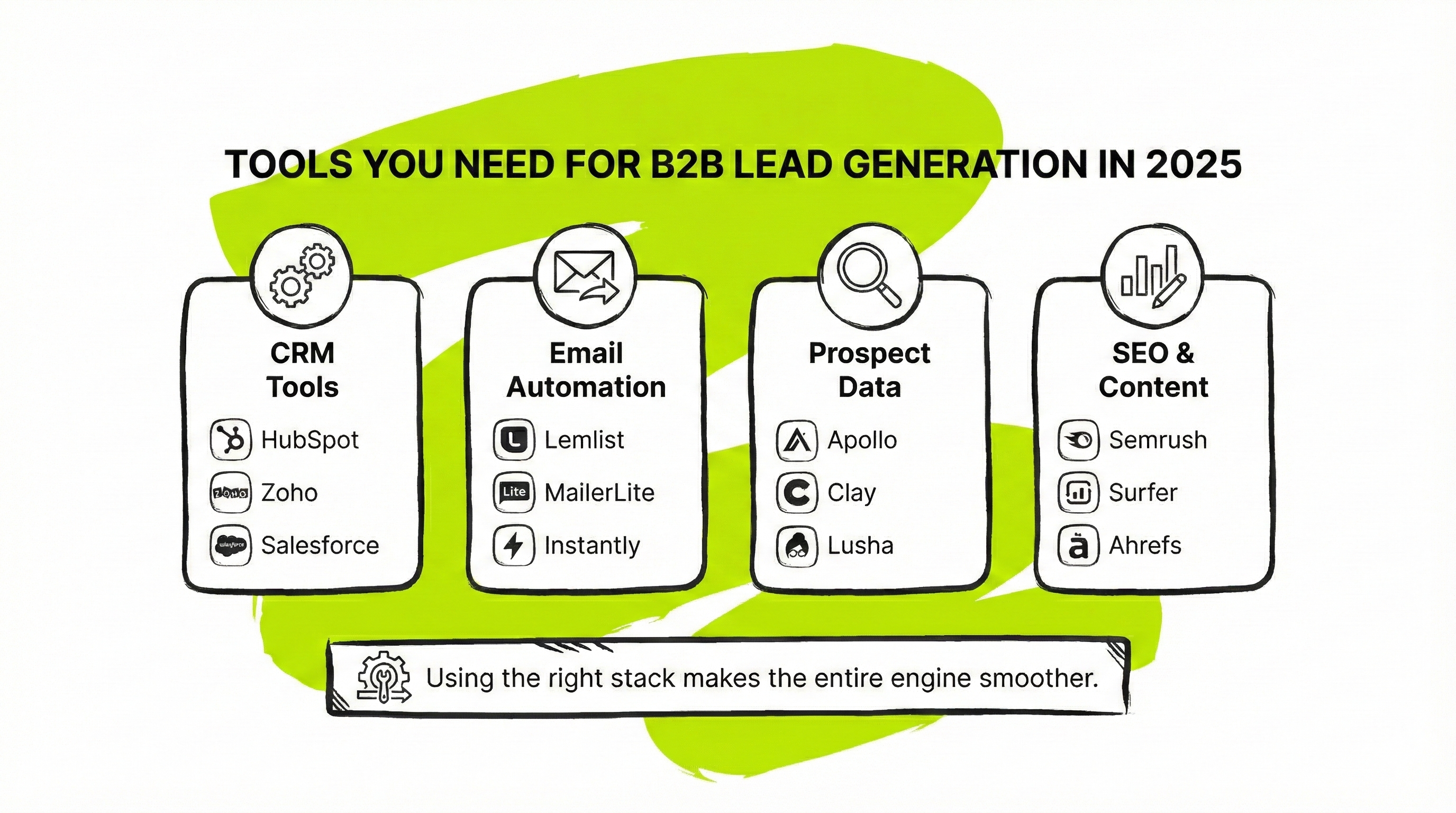
Tools You Need for B2B Lead Generation in 2025
CRM Tools
- HubSpot
- Zoho
- Salesforce
Email Automation
- Lemlist
- MailerLite
- Instantly
Prospect Data
- Apollo
- Clay
- Lusha
SEO & Content
- Semrush
- Surfer
- Ahrefs
Using the right stack makes the entire engine smoother.
Best Practices for B2B Lead Generation in 2025
Here are the rules successful companies follow:
✔ Personalization for every ICP
Never send the same message to everyone.
✔ Use content to warm up prospects
Great content reduces friction.
✔ Don’t rely on one channel
Diversification reduces risk.
✔ Offer high-value lead magnets
Templates, checklists, frameworks, reports.
✔ Use retargeting aggressively
People rarely convert the first time.
✔ Measure everything
CPL, CAC, conversion rate, pipeline velocity.
Conclusion
B2B lead generation in 2025 is not about mass outreach or buying lists.
It’s about:
- Understanding your ideal customers
- Attracting them with value
- Nurturing them patiently
- Building trust
- And then converting them at the right moment
Companies that follow this structured approach will consistently generate predictable, high-quality leads — regardless of market competition.
